
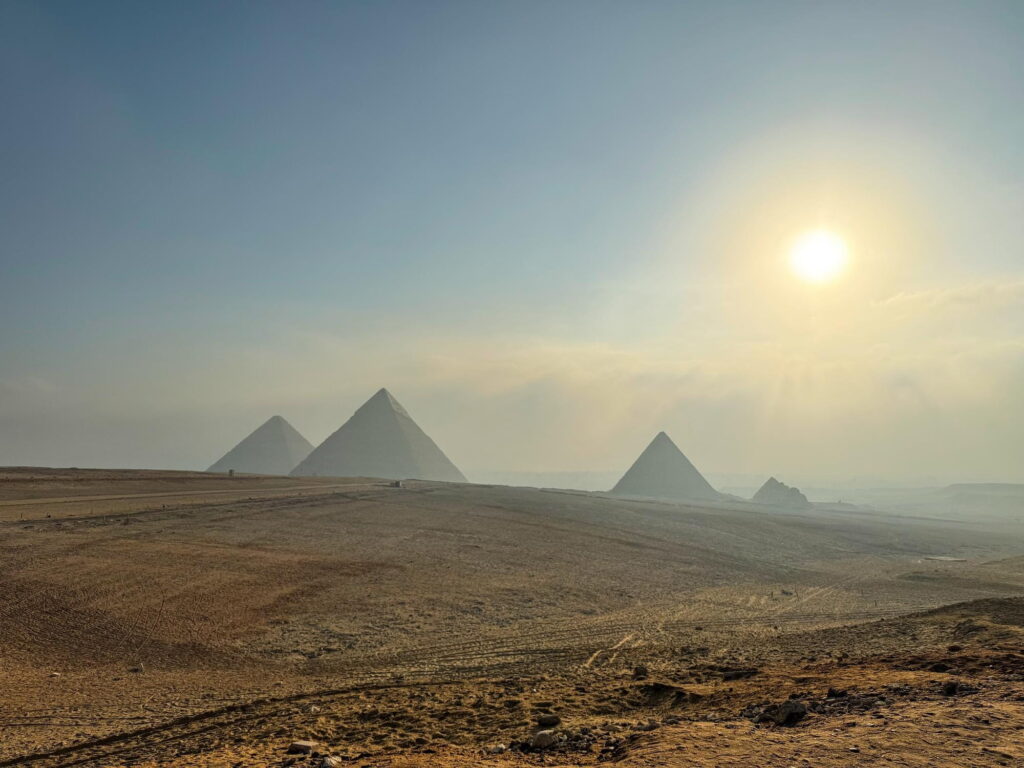
More than four thousand years ago, long before modern machinery or steel tools, humanity shaped one of the most enduring monuments ever created — the pyramid.
At its core, the pyramid is not a symbol of power alone. It is a declaration of faith in stone.
Among all ancient structures, none speak more clearly about permanence than the Great Pyramid of Giza.
Stone Chosen to Defy Time
The pyramids were built almost entirely from limestone, with granite reserved for chambers of great importance. Each stone block weighed several tons, quarried, transported, and placed with astonishing precision.
Stone was chosen deliberately.
In ancient Egypt, stone represented eternity. Unlike mudbrick, which eroded with seasons, stone promised permanence beyond life itself. To build in stone was to prepare for the afterlife.
The pyramid was not meant to impress the living — it was built for forever.
Precision Without Technology
What makes the pyramids extraordinary is not only their scale, but their accuracy.
Each block was cut and placed so precisely that even today, modern tools struggle to replicate the same tolerances.
No mortar as we know it.
No steel reinforcements.
Only stone, geometry, gravity, and human mastery.
The pyramid proves that stone, when respected and understood, becomes both structure and science.
Stone as Sacred Geometry
The pyramid’s form is no accident. Its angles, proportions, and orientation align with celestial movements and cardinal directions. Stone became the medium through which Egyptians connected earth to sky.
The pyramid’s geometry reflects:
Balance
Order
Cosmic harmony
In this sense, stone was not passive material — it was a bridge between the physical and the eternal.
Stone That Carries Memory
Precision Without Technology
What makes the pyramids extraordinary is not only their scale, but their accuracy.
Each block was cut and placed so precisely that even today, modern tools struggle to replicate the same tolerances.
No mortar as we know it.
No steel reinforcements.
Only stone, geometry, gravity, and human mastery.
The pyramid proves that stone, when respected and understood, becomes both structure and science.
Stone as Sacred Geometry
The pyramid’s form is no accident. Its angles, proportions, and orientation align with celestial movements and cardinal directions. Stone became the medium through which Egyptians connected earth to sky.
The pyramid’s geometry reflects:
Balance
Order
Cosmic harmony
In this sense, stone was not passive material — it was a bridge between the physical and the eternal.
Stone That Carries Memory
Over millennia, sandstorms have softened edges, footsteps have polished surfaces, and sunlight has aged the limestone.
Yet the pyramids remain.
Stone does not disappear — it records time.
Every weathered face, every worn edge is history written directly into material. The pyramid stands today not as ruin, but as proof that stone ages with dignity.
From Monument to Modern Design
The philosophy behind the pyramids still shapes how stone is used today.
Floors echo the solidity of ancient platforms
Walls recall the calm strength of limestone blocks
Stone furniture reflects sculptural permanence
When stone is used in contemporary interiors, it carries forward the same intention: to endure.
What the Pyramid Teaches Us Today
The pyramids remind us that true craftsmanship is patient.
That materials matter.
That building for longevity requires respect for both material and method.
In an age of temporary construction, the pyramid stands as a lesson carved in stone:
Build less. Build better. Build to last.